Buyer Guide
Rigid Box vs Folding Carton: Which One Does Your Product Need?
A cost, freight and perception comparison between the two dominant retail packaging formats, with a decision checklist.
Structural Design Team7 min read
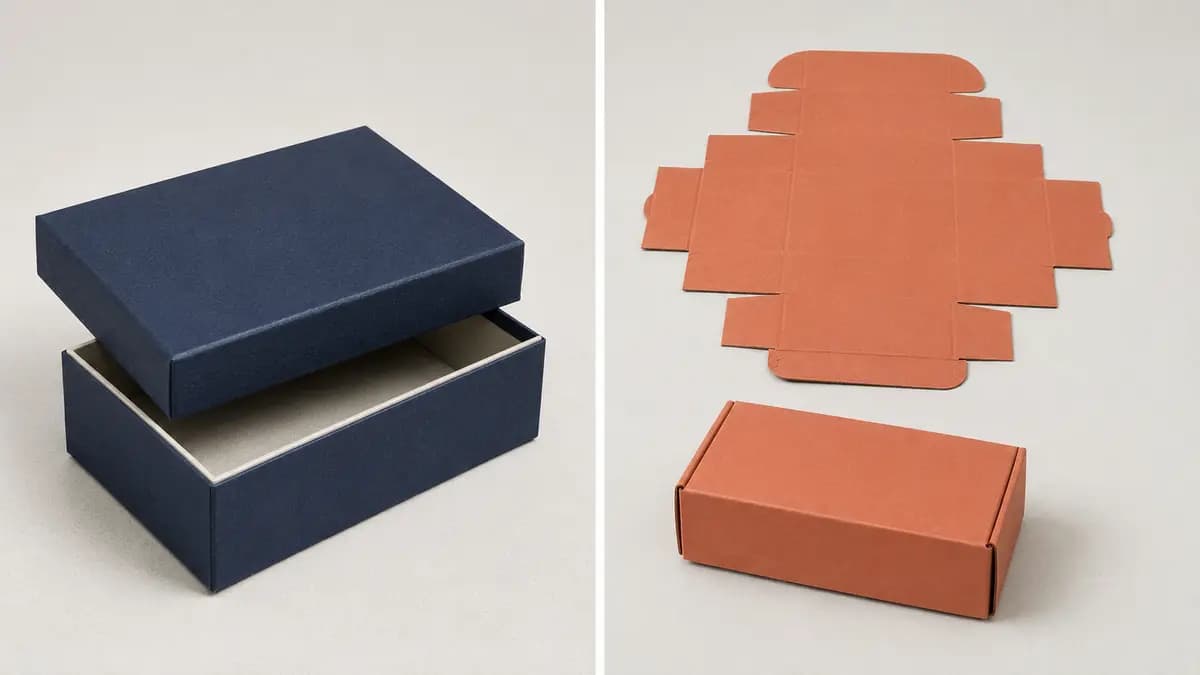
Rigid boxes and folding cartons cover the majority of retail packaging between them, and buyers routinely choose the wrong one — usually the expensive one.
Here is how the two compare on the four dimensions that actually decide the answer: unit cost, freight cost, perceived value and lead time.
Unit cost: folding cartons win, often by 3–5×
Folding cartons are printed on large sheets, die-cut and glued in a continuous process. Rigid boxes require board cutting, wrapping, corner taping and assembly — several of those steps still hand-assisted even in automated factories.
At 5,000 units, a mid-size folding carton typically lands between USD 0.25 and 0.60. A comparable rigid box lands between USD 1.20 and 3.00.
Freight: the hidden multiplier
Folding cartons ship flat. So do foldable magnetic rigid boxes. Traditional set-up rigid boxes ship assembled, which means you are paying ocean freight for air — often three to four times the container count for the same unit quantity.
If your programme is large and your margin is tight, a foldable magnetic construction recovers most of the rigid-box presentation while keeping freight near carton levels.
Perceived value: rigid still leads, but the gap is closing
Consumer research consistently shows rigid boxes read as more valuable, driven mainly by weight and by the resistance felt when opening. That advantage narrows sharply once a folding carton receives soft-touch lamination, foil stamping and a well-fitted insert.
For products above roughly USD 150 retail, rigid usually still pays for itself. Below that, a premium-finished carton is generally the better commercial decision.
Decision checklist
Choose rigid when most of these are true:
- Retail price above USD 150, or the box is a gift in itself
- The box will be kept and reused by the customer
- Unboxing is a marketing asset you will film
- Volumes below 20,000 units, where tooling amortisation matters less
- Product needs a deep, structured insert